 Isometric Partners
October 15, 2026
4 min read
Why Enterprise AI Stalls at the Task Level, and How Connected Decision Systems Close the Gap.
Automation runs a single task the same way every time. An agent carries a piece of work by gathering context across your systems, remembering how your firm operates, and adapting when something changes. Here is what that difference looks like in an ordinary week, why most company-wide AI rollouts stall before reaching the income statement, and where the judgment must stay with your people.
If you run an established mid-sized business, most of the artificial intelligence marketing aimed at you misses the mark. It promises to draft your client emails faster or summarize your meetings, when you already have capable people who do both well. Looking at those pitches and deciding the disruption isn't worth saving four minutes on an email is a completely reasonable business judgment.
The market numbers bear that out. Almost every company now has access to frontier AI, whether built into office suites like Microsoft 365 Copilot and Google Workspace with Gemini, or licensed through standalone seats of Anthropic's Claude and OpenAI's ChatGPT Enterprise. Yet a wide gap sits between buying software licenses and changing how work actually moves:
MIT's researchers identified the exact reason: 60% of enterprise users say AI tools require too much manual background explanation every time they open a new window, and 65% say the tools fail to learn from feedback.
Comparing your team to a single-task chat window asks the wrong question. The real operational drag in a mid-sized company rarely sits inside a single task. It sits in the work that never appears on anyone's job description: the connecting, chasing, reconciling, and re-explaining between the systems your business already runs on.
Automation is a straight line. When an invoice arrives, file it. When a form is submitted, add a row to a spreadsheet. That works well for a routine that never changes, but most commercial work is usually not a straight line.
Take a common Tuesday afternoon scenario in a manufacturing or distribution firm: a long-standing customer emails an urgent request to expedite a 400-unit custom order by ten days.
A rule-based script ("Task Bot") can log that email in your CRM. A chat window in Claude, ChatGPT, or Gemini can draft a polite reply. Neither can answer the customer's question. Answering it properly requires an experienced operations manager to act as a human bridge across four disconnected places:
In its 2026 Technology Report, Bain & Company measured the cost of this manual bridging across the economy, identifying a $100 billion opportunity hiding in "cross-system labor," the high-salaried human effort spent assembling decision context across separate software tools. Bain notes that over 90% of this value remains uncaptured because traditional automation stops at the edge of each software application.
Closing that gap is harder than buying a new software vendor's pitch. While McKinsey's State of AI survey shows 62% of organizations are experimenting with AI agents, only 23% have scaled them into daily operations. Worse, Gartner predicts that more than 40% of agentic AI projects will be canceled by the end of 2027, citing unclear business value, rising costs, and weak risk controls. Out of thousands of vendors claiming "agentic" features, Gartner found only roughly 130 were building true agents; the rest were engaging in "agent-washing," rebranding rigid scripts and basic chatbots under a new name.
Moving past basic automation means building AI into the workflow between your systems rather than treating it as a separate chat tab your staff has to visit. Regardless of whether the underlying model is Claude, GPT, or Gemini, an agent built for business operations differs from a task bot in four practical ways.
| Operational Dimension | Task Bots & Standalone Chat Windows | Agents That Know Your Business |
|---|---|---|
| 1. System Reach | Stuck inside one app or shallow off-the-shelf connectors; staff must copy-paste figures across windows. | Pairs native office connectors with custom data bridges to read live ERP, CRM, and financial ledgers together. |
| 2. Business Memory | Starts from zero every session; forces staff to re-explain company rules, formats, and history daily. | Holds persistent memory of your decision rules, margin thresholds, house style, and client history. |
| 3. Handling Exceptions | Breaks the first time a vendor changes an invoice layout or a customer asks for a non-standard term. | Reads the meaning of documents, flags rule conflicts, and carries human corrections forward. |
| 4. Long-Term Value | Static tool; no more capable on its thousandth day than on its first. | Compounding asset; expands from single tasks to end-to-end chains as it learns your environment. |
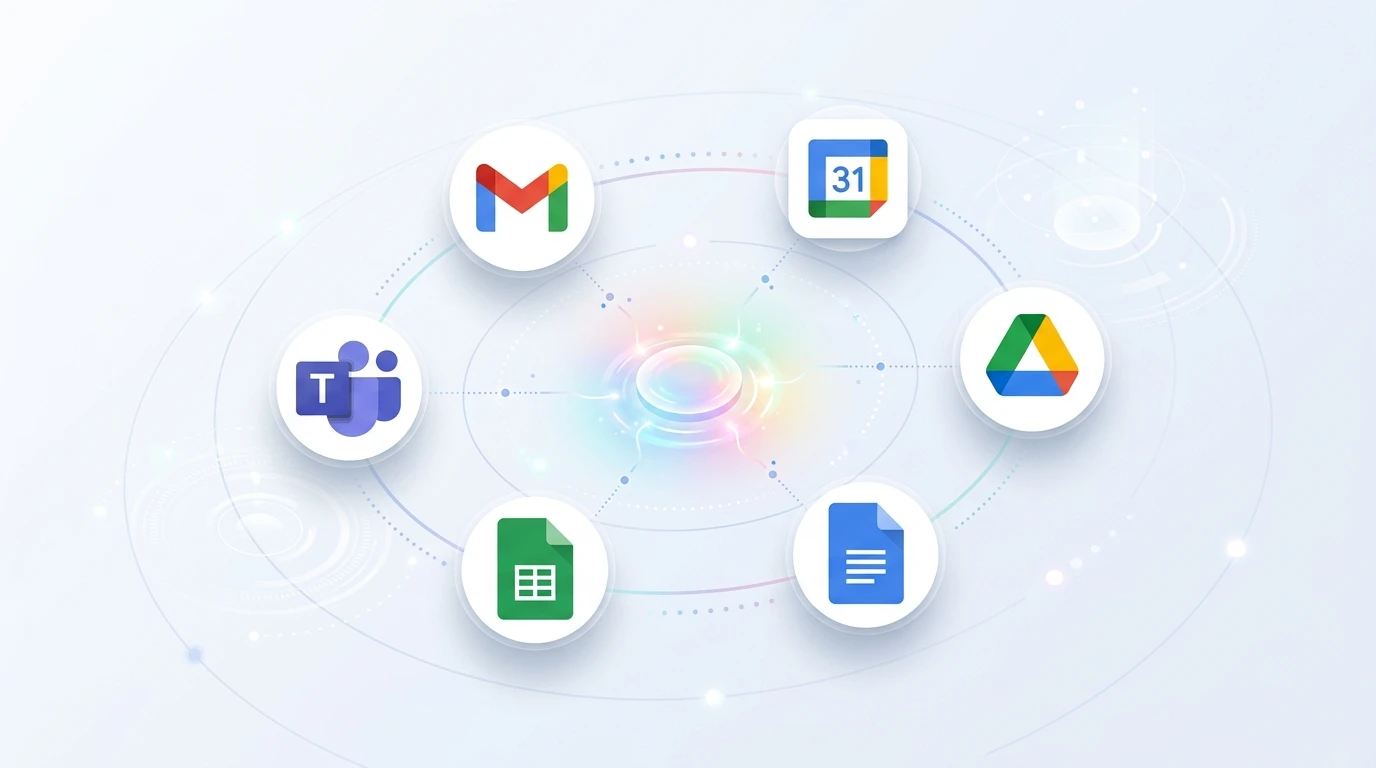
Major AI providers have started rolling out built-in connectors for Microsoft 365, Google Workspace, and common cloud software. That is a useful start, though off-the-shelf connectors remain shallow and rarely reach a mid-sized company's specialized ERP, accounting database, or custom pricing sheets. A complete setup uses those native connectors where they work and adds custom data bridges, using standards like the Model Context Protocol or direct API gateways, to reach the systems vendors won't connect out of the box. In the rush-order example above, the agent reads the incoming email, checks the contract in Drive, queries live ERP line capacity, and prepares a summary before your manager even opens the thread. The point isn't speed. It's that the context arrives with the task.
Many firms try to fix AI amnesia by dumping thousands of old PDFs and shared folders into a searchable database. That only creates a faster way to quote outdated files. Across the mid-market operations we audit at Isometric Partners, we consistently find that the rules actually governing things like pricing exceptions, credit holds, and rush approvals rarely live in an official manual. Instead, they live in email threads and history, fragmented files and the judgment of three or four veteran managers. To build an agent that knows your business, you start by shadowing those senior operators through real historical exceptions to map how your firm truly makes decisions before touching the technology: which system holds the authoritative number when two reports disagree, what unwritten margin and approval rules apply, and what recent history matters for a given scenario. Once those rules are encoded, you explain your business once rather than every session.
A rigid script breaks the first time a supplier changes the layout of its monthly PDF invoice, forcing someone to call IT. An agent works from the actual meaning of the document rather than its exact visual template. More importantly, when an agent miscategorizes a specialty material cost on a bid and an estimator corrects it, that correction carries forward. Instead of rewriting brittle code, you are training a system that remembers.
A standard software tool is as capable on Day 1,000 as on Day 1. An agent starts narrow and widens as it accumulates your firm's decision history and exception handling. Two competitors can license the exact same AI model tomorrow, but eighteen months from now, the firm whose system holds eighteen months of verified operational context will run at a structural advantage. Across 2026 workforce studies from McKinsey and the Slack Workforce Index, staff working with production agents reclaimed a median of 6.4 hours per week, capacity that grows as workflows expand from intake sorting to full quote-to-cash and invoice-to-payment chains.
Connecting an agent across your operational systems introduces a serious question: how do you know you can trust it when real money, client relationships, and compliance are on the line? Moving an agent from a promising demo into daily operations requires four safeguards working together.
Language models are built to read messy text, summarize documents, and spot patterns, not to improvise arithmetic or guess at compliance rules. In a real business, "the AI felt like this was the right figure" will never survive an audit. Reliable systems separate reasoning from calculation. The AI reads the email and extracts the request, but every pricing formula, margin check, and financial rule runs inside strict, traditional code where every number traces directly back to its source record.
In a July 2026 VentureBeat study of 157 enterprises, 50% of companies that tested their agents before launch still shipped an agent that failed a customer in live operations, and only 5% fully trusted their automated testing. The reason is simple: most teams only check whether the agent's final answer sounds polite and plausible, which recent Claw-Eval benchmarks show misses 44% of policy and process violations along the way, such as quoting a rush discount after skipping an inventory check. Before an agent goes live, it must be stress-tested against a "Golden Dataset" of your firm's actual historical edge cases, including messy broker notes, conflicting contract dates, and out-of-stock items, to verify it follows the right steps in the right order every time.
An agent that connects to your company's databases cannot have a master key to the entire building. A 2026 analysis of 177,000 agent tools by the UK's AI Safety Institute found that tools allowing agents to take direct action, such as altering records, sending external messages, or moving funds, jumped from 24% to 65% of usage in sixteen months. Yet Gartner's 2026 survey found that while 75% of firms are piloting or deploying agents, only 13% strongly agree their security governance is adequate. Production agents must enforce strict role-based permissions: an agent helping an account manager can read client contracts and stage a quote, but is locked out of payroll records and cannot issue a credit or sign off on a contract above its written authority limit.
None of this replaces human judgment. An agent should prepare the decision, not make it. Equally important, it should not dump a ten-page wall of unverified text on a manager's desk, trading prompt fatigue for review fatigue. Well-designed systems compress the four hours a senior person spends hunting across spreadsheets and folders into a ten-second verification brief.
Consider how all four safeguards come together in a commercial insurance or specialty lending intake workflow:
As Oliver Wyman noted in its 2026 study of business services, clients and markets will always pay a premium for human judgment, industry context, and clear accountability. The mid-sized firms pulling ahead are using agents to strip away the administrative tax that keeps their best people from using that judgment.
You do not need a massive platform overhaul or a grand strategy to begin. Instead of asking, "What tasks can we automate?" ask the question that actually moves your business forward: "What would our best people do with the capacity that cross-system administrative work is currently eating?" "What business goal are we trying to solve?"
Pick one piece of connective work that drains a senior person's week: the weekly operational report assembled from three systems, the complex quote that stalls waiting on four checks, or the intake review that depends on rules trapped in one director's head. Map how that decision is really made, including the exceptions, the access boundaries, and what you need to see on screen to trust the number. Then build from there.
Most businesses find that solving just two or three of these core bottlenecks removes the majority of their operational drag. The point was never just to automate everything; it is to put your people back in command of the work that matters, the work that drives outcomes towards your business and operational goals.
Answers about scope, ownership and getting started.